
Open 24/7, weekends & holidays
 IDA Certified Residential & Commercial
Garage Door Maintenance & Safety Tune-Up in MD
Fast Service. Fair Pricing. Great Warranty.
- Same-day service available
- A firm price before any work begins
- Fixed in one trip with fully stocked trucks
- Maryland licensed, MHIC #138235
Prefer to text? Text us at (410) 600-1031
Garage door not working?
$45 service call
Diagnose a problem (waived with service).
Book Your Appointment Or call (410) 600-1031










Garage door maintenance and the Safety Tune-Up
Garage door maintenance means testing the door’s balance and the opener’s safety features, checking springs, cables, rollers and hardware, and lubricating the parts the manufacturer names. DASMA, the door industry’s association, recommends monthly safety checks by the homeowner and a yearly visit from a trained technician. ADP’s Safety Tune-Up starts at $149 across Central Maryland, and we are open 24/7 with a firm price before any work begins.
Regular garage door maintenance is the cheapest repair there is: it finds a frayed cable, a worn roller or a door out of balance before it turns into a broken door on a Monday morning. Below: how often to service a garage door, what a technician checks, which parts to lubricate (and which not to), and the monthly checks you can do yourself. Every check on this page comes from DASMA or from the door and opener makers.
- 1,060+ tune-up, maintenance and lubrication jobs since June 2020
- Monthly safety checks by the homeowner, as DASMA and LiftMaster recommend
- Yearly visit from a trained door technician, as DASMA recommends
Counts come from our own Housecall Pro job records (June 2020 to November 2026). Schedule from DASMA’s safety tips (dasma.com) and LiftMaster and Chamberlain’s “Garage Door Opener | Recommended Maintenance” (support.chamberlaingroup.com), checked November 2026.
How often should you service a garage door?
DASMA calls the garage door the largest moving part in most homes and recommends monthly safety checks plus an annual visit from a trained door systems technician. The door and opener makers add their own schedule:
| How often | What | Who says so |
|---|---|---|
| Once a month | Look over the door and hardware, run the door and listen, test the automatic reverse with a 2x4 and test the safety sensors | DASMA; LiftMaster and Chamberlain |
| Every 3 to 12 months | Review springs, cables, rollers, track, hinges, panels and the bottom seal | Clopay (at least once a year, as often as every three months) |
| Once a year | Lubricate the door’s moving parts; test the opener’s battery backup if it has one | LiftMaster and Chamberlain; Clopay |
| Once a year | Visit from a trained door technician | DASMA |
| Every 2 to 3 years | Grease the opener rail, only if the opener’s manual calls for it | LiftMaster and Chamberlain |
Clopay’s lubrication guide adds that a door in heavy daily use may need lubricating every 3 months, and a door in average use about every 6 months; dust, humidity and older parts shorten the interval.
From DASMA’s safety tips for garage door systems (dasma.com), LiftMaster and Chamberlain’s recommended maintenance (support.chamberlaingroup.com), and Clopay’s Garage Door Maintenance Guide and lubrication guide (clopaydoor.com), checked November 2026.
Garage door tune up and safety inspection: what we check
A garage door safety inspection follows the points DASMA lists in its checklist for home inspectors and homeowners (TDS 167) and the maintenance steps in the door and opener makers’ guides. On a Safety Tune-Up we go through them on your door:
- Balance test. With the opener disconnected, the door should move freely by hand and stay put when stopped 3 to 4 feet above the floor. A door that drifts up or down has springs that need adjusting or replacing.
- Springs and spring containment. We look for broken, gapped or worn springs. Extension springs need a safety cable running through them so a broken spring cannot fly loose.
- Lift cables. Fraying, rust, kinks, slack, and cables seated correctly on the drums or pulleys.
- Rollers, hinges and track. Rollers should turn smoothly and stay in the track; hinges should not be bent or cracked; tracks should be straight and firmly attached to the jambs and the ceiling hangers.
- Hardware. Hinges, brackets and fasteners secure, and the opener firmly attached to the door and the ceiling, with its reinforcement bracket in place.
- Lubrication. The points the manufacturer names (see below), with excess wiped off and nothing on the tracks.
- Photo eye test. The sensor beam no higher than 6 inches above the floor, and the door reverses when the beam is broken.
- Auto reverse test. A 2x4 laid flat under the middle of the door: the door must reverse when it touches it.
- Manual release, wall button and labels. A red release handle no more than 6 feet above the floor, a wall button at least 5 feet up and in sight of the door, and the spring and safety warning labels in place.
- Panels and bottom seal. Sections free of cracks or separation, and a bottom weather seal that is not cracked or letting in drafts.
If we find a worn or broken part, you get a firm price for that repair before any work begins.
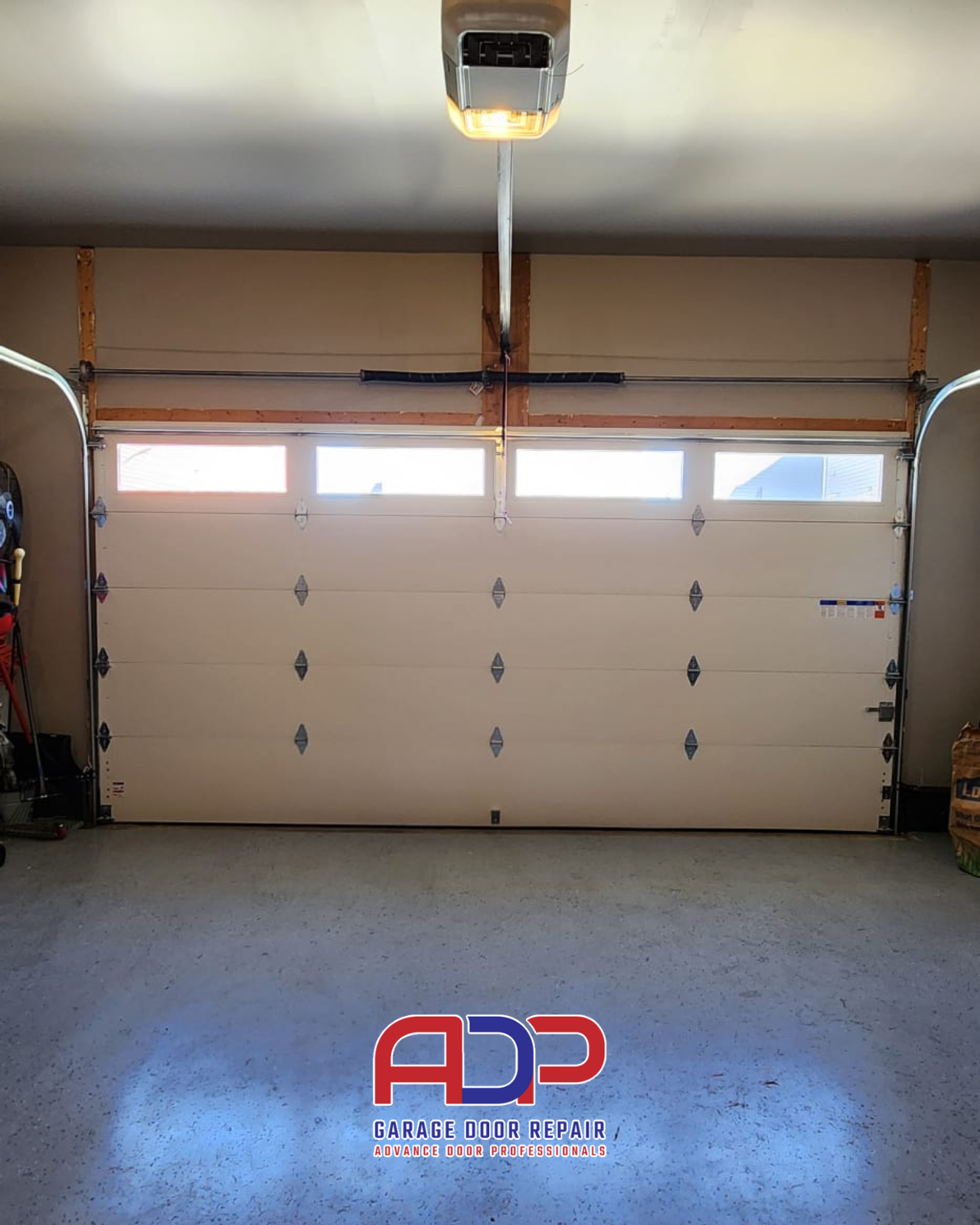
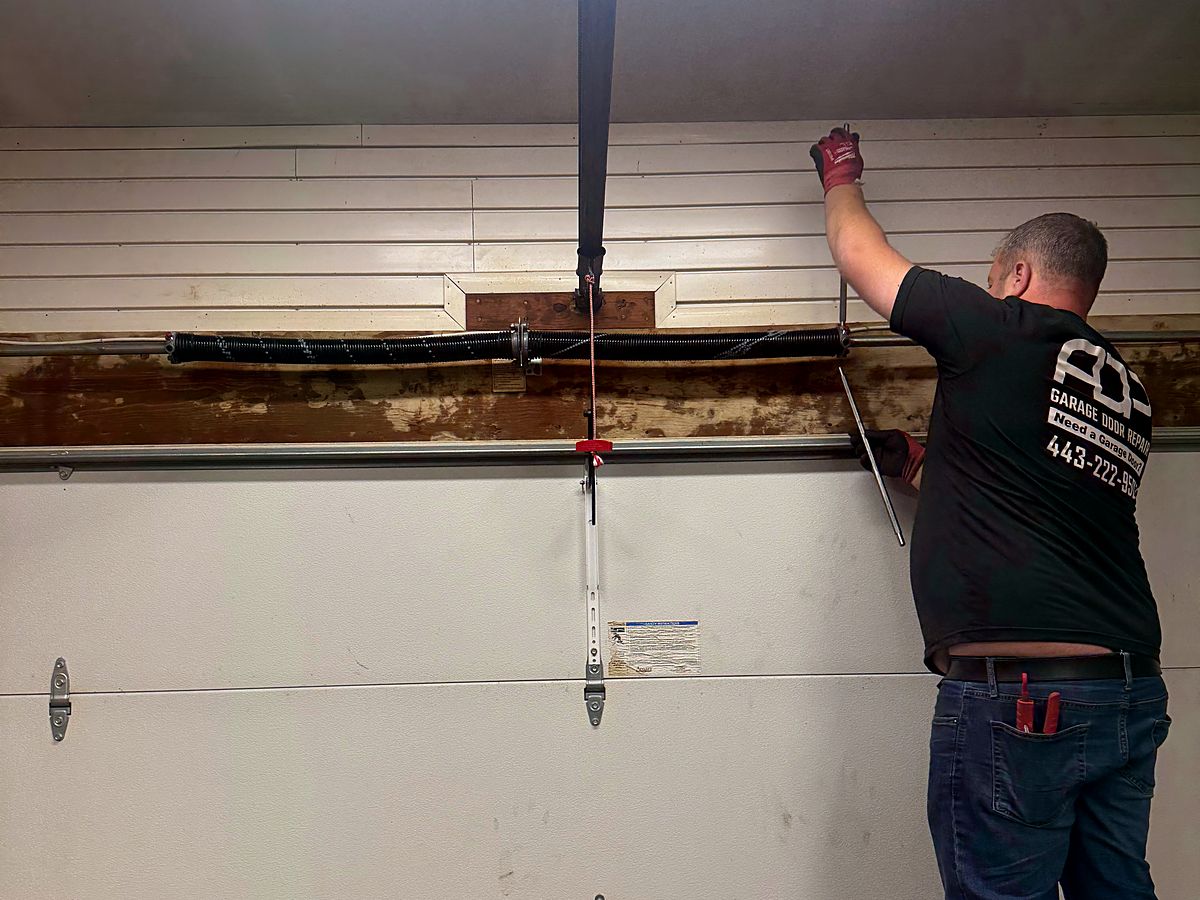
From DASMA TDS 167, Residential Sectional Garage Door and Electric Operator Checklist (dasma.com), DASMA’s safety tips, and Clopay’s Garage Door Maintenance Guide (clopaydoor.com), checked November 2026.
Garage door lubrication: what to lubricate, and what not to
Lubrication cuts noise and wear. The makers agree on most of it:
- Lubricate: hinges, rollers and their bearings, and the bearings at the ends of the spring shaft. LiftMaster says a small amount of garage door lubricant on the rollers, bearings and hinges, once a year. Clopay also lists the torsion springs, sheave bearings and the lift cables at the bottom corners; on a tune-up we handle those points, because they sit under spring tension.
- Not on nylon rollers: Clopay says not to lubricate nylon rollers.
- Not on the tracks: both LiftMaster and Clopay say not to lubricate the tracks. Clean them with a small brush and a damp cloth instead.
- What to use: a lubricant made for garage doors. Clopay recommends a silicone based spray or a lithium grease spray and advises against WD-40, which attracts dirt and dust.
- How much: a little. Wipe off anything that drips; excess lubricant collects dirt.
If the door is still noisy after lubricating, the rollers or hinges may be worn out. A set of up to 10 nylon rollers is $179 on our price list.
From LiftMaster and Chamberlain’s recommended maintenance (support.chamberlaingroup.com) and Clopay’s “How to Properly Lubricate Garage Door Components” and Garage Door Maintenance Guide (clopaydoor.com), checked November 2026.
Monthly garage door safety checks you can do
DASMA’s homeowner guide and LiftMaster’s maintenance page describe the same few checks. Do them in this order.
- Look and listen. With the door closed, look for wear or damage on hinges, rollers, springs, cables and panels. Run the door with the opener and watch for sticking, jerking or one side moving ahead of the other.
- Balance test. With the door fully closed, pull the red release cord to disconnect the opener. Lift the door by its handles: it should move freely and stay about 3 to 4 feet off the floor. If it is heavy, will not stay put or slams down, stop and call a technician. If it passes, close it and reconnect the opener.
- Auto reverse test. Open the door, lay a 2x4 flat on the floor under the middle of the door and close it with the opener. The door should reverse when it touches the board.
- Photo eye test. While the door is closing, pass an object through the sensor beam near one sensor, keeping yourself out of the door’s path. The door should stop and go back up.
- Sensor height. The sensors should be no higher than 6 inches above the floor.
What to leave to a technician. Never loosen, adjust or remove springs, cables, pulleys, bottom brackets or red painted fasteners: they are under high tension, and DASMA and the makers warn that it can cause serious injury or death. Never pull the release while the door is open, because a door with a weak or broken spring can fall. If any check fails, stop using the door and call us.
From DASMA’s Automatic Garage Door Opener Safety & Maintenance Guide and TDS 167 (dasma.com), LiftMaster and Chamberlain’s recommended maintenance (support.chamberlaingroup.com) and Amarr’s FAQ (amarr.com), checked November 2026.
How much is a garage door tune-up in Maryland?
Our Safety Tune-Up starts at $149. If the checks turn up a part that needs replacing, you get a firm price before any work begins. Starting prices from our published price list:
| Service | Starting at |
|---|---|
| Safety Tune-Up | $149 |
| Roller replacement (set, up to 10 nylon rollers) | $179 |
| Cable replacement (pair, both lift cables) | $189 |
| Extension spring replacement | $349 |
| Torsion spring replacement | $495 |
| Torsion spring replacement, 2 springs | $595 |
We offer military and senior discounts and financing with a quick prequalification. For commercial doors, ask for a free estimate; fire doors have their own drop testing.
Garage door maintenance questions
Is a garage door tune-up worth it?
Amarr notes that worn springs make a door heavy, which loads the opener and its reversing system and can wear the opener out early. DASMA adds that an out of balance door is not fixed by a stronger opener: openers are designed for balanced doors. A yearly check catches these problems while they are still small.
Should I grease the garage door tracks?
No. LiftMaster and Clopay both say not to lubricate the tracks. Keep them clean instead.
Can I use WD-40 on my garage door?
Clopay advises against it because it attracts dirt and dust. Use a silicone or lithium spray made for garage doors.
How often should I test the auto reverse?
Once a month, with a 2x4 laid flat under the door, as DASMA and LiftMaster recommend. If the door does not reverse, stop using the opener and call a technician.
Garage door maintenance in Maryland
ADP Garage Door Repair does Safety Tune-Ups for homes across Central Maryland, starting at $149. We are open 24/7, and you get a firm price before any work begins. If something is already broken, the $45 service call is waived when we do the repair.
What our customers say
Rated 5.0 stars from 1,266 Google reviews
Our Prices
prices starting from
- Service Call $45 Diagnose a Problem (Waived with Service).
- Safety Tune-Up $149

We offer financing
Prefer to pay over time rather than all at once? Prequalify for financing today.
*All financing is subject to credit approval. Your terms may vary. Payment options through Wisetack are provided by our lending partners. For example, a $5,500 purchase could cost $253.54 per month for 24 months, based on a 9.9% APR, or $1,833.33 per month for 3 months, based on a 0% APR. Offers range from 0 to 35.9% APR based on amount requested and creditworthiness. Not all merchants and lending partners participate in 0% interest programs. Terms range from 3 - 120 months and may vary based on merchant, lending partner, or transaction size. State interest rate caps may apply. No prepaid finance charges or participation fees. See additional terms at wisetack.com/faqs.