Open 24/7, weekends & holidays
 IDA Certified Residential & Commercial
Commercial Garage Door Preventive Maintenance in Maryland
Fast Service. Fair Pricing. Great Warranty.
- Same-day service available
- A firm price before any work begins
- Fixed in one trip with fully stocked trucks
- Maryland licensed, MHIC #138235
Prefer to text? Text us at (410) 600-1031
Commercial door project?
Free estimate
Call us, or text us photos, and we will give you a price before any work begins.
- No charge and no obligation
- Photos by text are enough to start
- A firm price before any work begins











Commercial garage door maintenance for Maryland businesses
Commercial garage door maintenance is the scheduled inspection, lubrication, adjustment and safety testing of a building’s overhead doors and their operators. DASMA, the door industry’s association, recommends that a trained door systems technician inspect and maintain every rolling door at least once a year, and NFPA 80 requires a yearly inspection and drop test of every rolling fire door. ADP Garage Door Repair maintains commercial sectional, rolling steel, high speed, fire and loading dock doors across Central Maryland, 24/7, with a firm price before any work begins.
Many commercial doors run dozens of times a day: LiftMaster rates its standard duty commercial operators for up to 80 to 90 cycles a day, and its heavy duty models for more. This page lays out the commercial garage door preventive maintenance schedule the manufacturers and DASMA publish: what your staff can check each week or month, what a technician should do every few months or every few thousand cycles, and what fire doors need every year.
- 230+ commercial door jobs completed since June 2020
- 80+ commercial door jobs in the last 24 months
- Yearly inspection and drop test NFPA 80 requires for every rolling fire door
Counts come from our own Housecall Pro job records (June 2020 to November 2026) and cover all of our commercial door work. Requirements from DASMA Technical Data Sheets 270 and 271 and NFPA 80 (2022) as summarized in DASMA TDS 299 (dasma.com), checked November 2026.
Commercial garage door preventive maintenance schedule
Each manufacturer sets its own intervals, by time or by door cycles, whichever comes first. These are the published schedules for the door types we service. Staff checks are looking and testing only; adjustments belong to a trained technician.
| Door or part | Your staff checks | Trained technician | Who says so |
|---|---|---|---|
| Rolling steel doors | Weekly: damaged slats, endlocks or bottom bar, hang-ups, odd noise, sensing edge. Monthly: loose fasteners, torn bottom seal, noisy bearings, bent guides. Quarterly: brackets, drive chain, hood, operator mounting; electric doors evaluated for straining | Inspection and maintenance at least once a year, or as the manufacturer says | Cornell rolling door manual; DASMA TDS 270 |
| Rolling sheet doors | Test sensing devices at least weekly; electric doors evaluated quarterly | All adjustments, springs and repairs | DASMA TDS 286 |
| Commercial sectional doors | Routine maintenance steps once a month | Professional inspection once a year | Wayne Dalton commercial sectional owner’s manual |
| Door operators | Photo eyes and edges tested monthly | Every 3 months or 5,000 cycles, 6 months or 10,000 cycles, and 12 months or 20,000 cycles | LiftMaster Logic 5.0 manuals; DASMA TDS 382 |
| High speed doors | Daily look over the door and daily test of the sensing edge, photo eyes or light curtain | At least once a year, more often for very busy doors | Wayne Dalton rolling door end user maintenance manual |
| Rolling fire doors and fire shutters | Keep the opening clear; nothing attached to the door | Inspection and drop test at least once a year, by a trained rolling steel fire door technician | NFPA 80; DASMA TDS 271 and 299 |
DASMA adds one more rule: after high wind, an earthquake or a flood, have every door in the building evaluated right away, whenever the last inspection was.
Signs a commercial door needs service now
- The door will not stay open and has to be propped, or it drifts down after the operator stops
- The operator strains, hums or runs without moving the door
- The sensing edge, photo eyes or light curtain do not stop and reverse the door
- The door hangs up, jams, makes new noises, or the curtain rubs the hood
- Opening by hand takes more than about 35 pounds on a hand chain, 30 pounds pushing up, or 25 pounds on a crank
- The door does not stop at full open or full close
- A forklift or truck has hit the door, guides or bottom bar
Safety first. The springs and counterbalance of a commercial door are under extreme tension at all times. Never loosen the tension wheel, brackets, barrel, cables or bottom brackets. Cornell’s manual says not to run a door while any of these problems exist: stop using it and call a technician.
From DASMA TDS 269, 270, 286 and 375 (dasma.com), the maintenance schedule in Cornell’s rolling door installation manual (cornelliron.com), Wayne Dalton’s C-Series commercial sectional door owner’s manual and rolling door end user maintenance manual (wayne-dalton.com), and LiftMaster’s Logic 5.0 installation manual and user’s guide (liftmaster.com), checked November 2026.
Overhead door maintenance: rolling steel, sectional doors and operators
Rolling steel door maintenance
DASMA’s checklist for facility managers (TDS 269 and 270) is the basis of a rolling door inspection:
- Hood and guides: no dents that bind the curtain; guides evenly spaced top to bottom with a fastener in every slot; stops in place at the top of each guide.
- Curtain and bottom bar: not bent, moving freely in the guides, endlocks and windlocks tight and not rubbing the brackets.
- Balance: a manual door should rest on the floor or rise slightly when closed, and move toward the stops as it nears full open. The tension wheel and shaft should not move while the door runs.
- Limits: the bottom bar should not jam against the guide stops, and the curtain should not sag when closed.
- Labels: the product safety labels present and readable.
Under UL 325, a motor operated door without a working sensing edge or photo eyes must be wired so the close button has to be held down the whole time the door closes.
Commercial sectional door maintenance
Wayne Dalton’s commercial sectional door manual asks for routine maintenance once a month and a professional inspection once a year. The rollers should turn freely in clean tracks. On a maintenance visit, hinges, steel rollers, bearings and torsion spring coils get a non-silicone lubricant; nylon rollers, plastic idler bearings and the track itself are not lubricated. Wayne Dalton warns never to loosen anything on the counterbalance or the bottom corner brackets: they are connected to the springs and under extreme tension.
Spring life depends on how the door is used. DASMA lists the things that shorten it: corrosive chemicals in places like wash bays, doors left open for long periods in harsh weather, and a counterbalance that is not maintained as the manufacturer says. For doors that run all day, manufacturers such as Haas offer high cycle springs and rollers.
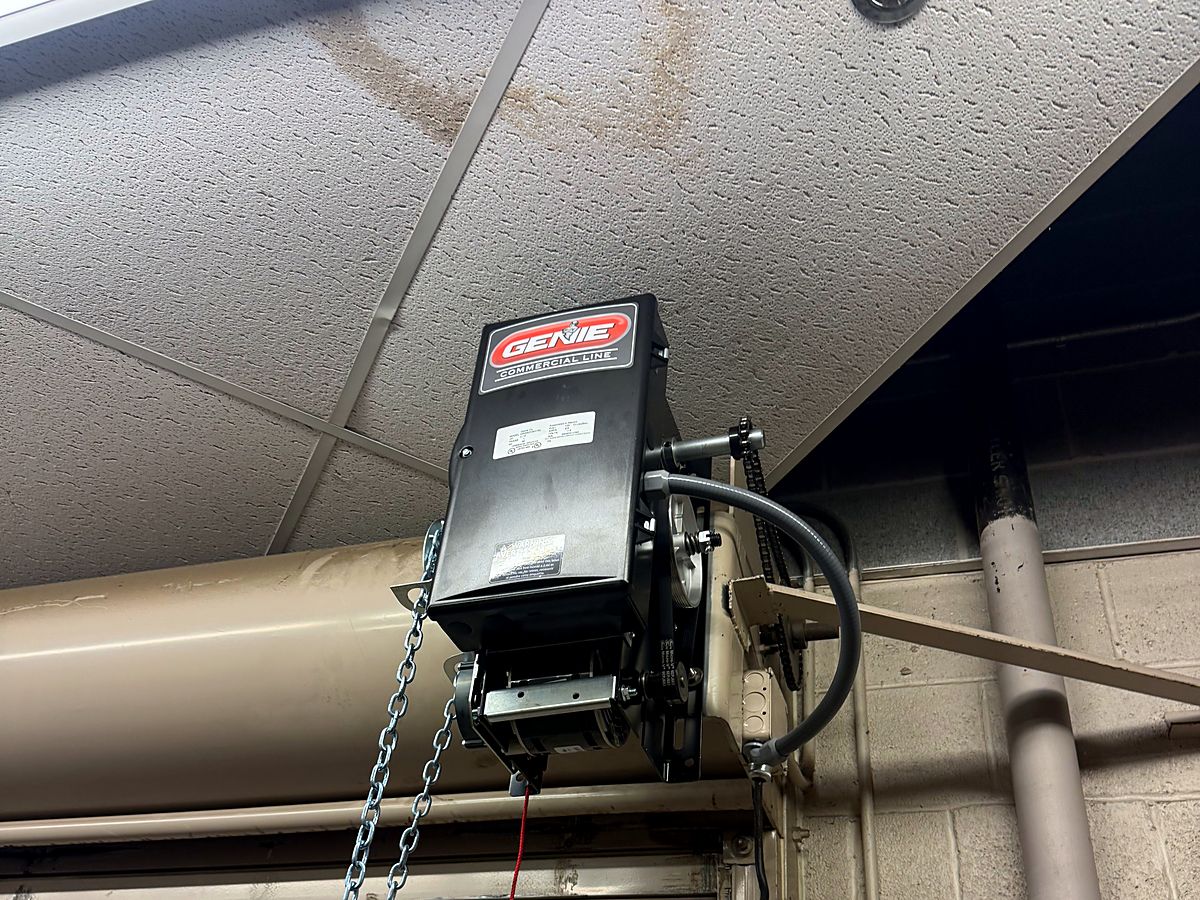
Commercial door operator maintenance
LiftMaster’s Logic 5.0 manual gives this schedule for its commercial operators, to be done by a trained technician with the power off:
| How often | What gets checked |
|---|---|
| Every month | Entrapment protection (photo eyes, edges): alignment and function |
| Every 3 months or 5,000 cycles | Drive chain slack and lubrication; sprocket set screws; non-motor bearings and shafts for wear and lubrication; repeat all the operator tests |
| Every 6 months or 10,000 cycles | Clutch; belt condition and tension; fasteners; manual disconnect; brake pad |
LiftMaster specifies SAE 30 oil, never grease or silicone spray, and no lubrication on the motor, clutch or V-belt. Its 3-button control station can flash a Maintenance Alert light when a set number of cycles or months has passed. DASMA adds that photo eyes used for entrapment protection must sit no higher than six inches above the floor and should be tested monthly; eyes mounted higher to protect vehicles do not replace them.
From DASMA TDS 190, 269, 270 and 382 (dasma.com), Wayne Dalton’s C-Series commercial sectional door owner’s manual (wayne-dalton.com), Haas Door’s commercial product brochure (haasdoor.com) and LiftMaster’s Logic 5.0 installation manual (liftmaster.com), checked November 2026.
Loading dock door and high speed door maintenance
Loading dock door maintenance
A dock door can be a sectional, rolling, sheet or high performance door, and DASMA notes that a heavy use dock door can cycle every hour around the clock. What to watch on a dock:
- Impact points. Mounting clips, weather seals and jamb brackets take frequent hits from forklifts; DASMA says they should be easy to replace or built to resist impacts.
- Balance. The counterbalance should keep the door from drifting down into the opening, where vehicles can hit it.
- Operator limits. Set to the floor and the header, with speeds that suit the dock.
- The fall hazard. A dock floor is typically 48 inches above the drive. DASMA says the door should not be open unless a trailer fills the opening or a barrier is in place, and interlocks can tie the door to the vehicle restraint.
- Seals and shelters help keep conditioned air in when a trailer is at the door.
DASMA’s advice for every dock door: follow the door manufacturer’s maintenance guidelines, and call a trained technician whenever there is any doubt about how a door is working. See our loading dock door services.
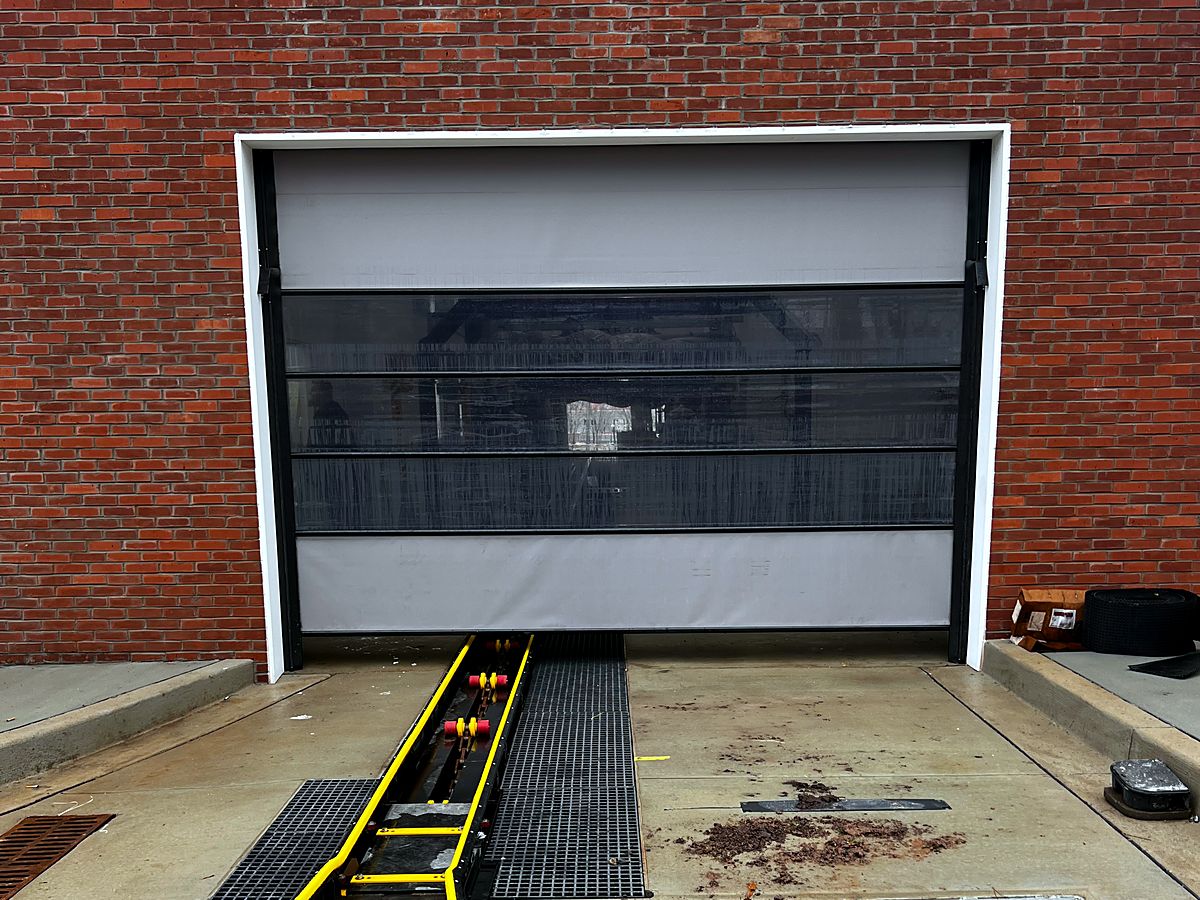
High speed door maintenance
Codes define a high speed door as one that opens at 32 inches per second or more and closes at 24 or more. Wayne Dalton’s end user maintenance manual for its rolling and high speed doors asks for:
- A daily look for loose bolts, damage and wear.
- A daily safety test of the sensing edge, photo eyes or light curtain with a solid object, never a hand or arm. If the door does not reverse, stop using it.
- Cleaning with mild soap and lukewarm water; no abrasive cleaners, harsh chemicals or pressure washers on the door or its vision panels.
- Breakaway reset after a hit, on fabric and rubber doors, by following the control panel. Other doors need a technician after any impact.
- Professional maintenance at least once a year, more often on very busy doors. A door with a control panel shows a maintenance message every 150,000 cycles.
See our high speed doors.
From DASMA TDS 182 (Technical Considerations for Dock Doors) and TDS 455 (High Speed Doors and Energy Conservation), dasma.com, and Wayne Dalton’s rolling door end user maintenance manual for its high speed doors (wayne-dalton.com), checked November 2026.
Fire door inspection and drop testing (NFPA 80)
NFPA 80 requires every rolling steel fire door to be inspected and drop tested at least once a year, including doors that stay closed and are never used. The test must be done by a trained rolling steel fire door systems technician, and keeping it done is the building owner’s responsibility.
The 2022 edition of NFPA 80 defines that technician as one with documented training from a recognized industry organization or from a manufacturer of listed rolling steel fire doors. DASMA reports that the 2024 International Fire Code adds the same yearly requirement. Our technicians hold the Institute of Door Dealer Education and Accreditation (IDEA) Rolling Steel Fire Door Technical Certification. DASMA’s four step procedure, recorded on its drop test form:
- Visual inspection. Block off both sides of the door, then check for missing or loose bolts, damaged slats and endlocks, bent guides, a damaged hood, and fusible links or release arms that are painted, greasy, tied or blocked. Nothing that is not part of the fire door may be attached to it.
- Operational test. Open and close the door normally and watch for anything abnormal.
- Drop test 1. Always from the fully open position: on doors that release spring tension, a drop test from a partly closed door can break the tension wheel or parts inside the barrel. The door must close completely and rest on the floor or sill, at an average speed between 6 and 24 inches per second.
- Reset and drop test 2. Reset the door to the manufacturer’s instructions and test again to prove the automatic closing device was reset. Each automatic closing option, detector and release device is tested.
A door that fails must be repaired with listed parts or parts from the original manufacturer, and pass again. Keep the acceptance test record for the life of the door and each yearly record for at least three years; final acceptance is up to the authority having jurisdiction. Cornell notes that the same yearly test applies to counter fire shutters and smoke and fire curtains.
When we drop test a door, we open and close it, check that its automatic closing device resets correctly, go over any repairs it needs with you, and give you the documentation that it was tested. See rolling door drop testing.
From DASMA TDS 252 (Test Rolling Fire Doors in the Fully Open Position ONLY), TDS 271 (Periodic Inspection and Drop Testing) and TDS 299 (Periodic Inspection and Technician Training Requirements, quoting NFPA 80, 2022 edition), dasma.com, and Cornell’s guide to fire door drop testing and NFPA 80 (cornelliron.com), checked November 2026.
What we do on a commercial door maintenance visit
- Tell us about your doors. How many, what kind, and roughly how often each one runs. Photos of each door and its label help: text them to us.
- Door by door inspection. Our technician checks bracket alignment, the curtain or sections, fasteners, locks, guides and hood, bearings and sprockets (lubricated as the manufacturer specifies), springs and cables, and every safety sensor and edge.
- Firm price first. If a door needs a repair, you get a firm price before any work begins.
- A schedule for your doors. We set up a maintenance schedule for your doors, based on the manufacturers’ intervals and how hard each door works.
- Fire doors. Yearly drop tests, with documentation for your records.
How much does commercial garage door maintenance cost?
It depends on how many doors you have, what kind they are, their size and how often they run, so commercial work is quoted per project. Ask for a quote. If a door is already broken, the $45 service call to diagnose it is waived when we do the repair, and estimates for new commercial doors are free.
Commercial door maintenance questions
How often should commercial garage doors be serviced?
At least once a year by a trained technician, as DASMA recommends for rolling doors and Wayne Dalton for commercial sectional doors. Busy doors need more: LiftMaster’s schedule for its commercial operators starts at every 3 months or 5,000 cycles, whichever comes first.
How often do rolling fire doors need a drop test?
At least once a year under NFPA 80, plus an acceptance test when the door is installed. Keep the yearly records for at least three years.
What can our maintenance staff check themselves?
The visual checks and safety tests in the schedule above: damage, noise, loose fasteners, and testing the edges and photo eyes. DASMA says adjustments and repairs must be made by a trained door systems technician, and fire door drop tests only by a trained rolling steel fire door technician.
Do you offer commercial garage door maintenance contracts?
We set up a maintenance schedule for your doors; ask for a quote. DASMA itself recommends that facility managers arrange yearly, or more frequent, fire door inspections with a rolling door service provider.
From DASMA TDS 270, 271 and 299 (dasma.com), Wayne Dalton’s commercial sectional door owner’s manual (wayne-dalton.com) and LiftMaster’s Logic 5.0 user’s guide (liftmaster.com), checked November 2026.
Commercial garage door maintenance in Maryland
ADP Garage Door Repair maintains and repairs commercial sectional, rolling steel, high speed, fire and loading dock doors for businesses across Central Maryland. We are open 24/7, including weekends and holidays, and you get a firm price before any work begins. Call us, or text photos of your doors, and ask for a maintenance quote.
What our customers say
Rated 5.0 stars from 1,266 Google reviews

We offer financing
Prefer to pay over time rather than all at once? Prequalify for financing today.
*All financing is subject to credit approval. Your terms may vary. Payment options through Wisetack are provided by our lending partners. For example, a $5,500 purchase could cost $253.54 per month for 24 months, based on a 9.9% APR, or $1,833.33 per month for 3 months, based on a 0% APR. Offers range from 0 to 35.9% APR based on amount requested and creditworthiness. Not all merchants and lending partners participate in 0% interest programs. Terms range from 3 - 120 months and may vary based on merchant, lending partner, or transaction size. State interest rate caps may apply. No prepaid finance charges or participation fees. See additional terms at wisetack.com/faqs.